원자력공학과, ‘원자력 안전규제라운드테이블’ 개최

연구 2026년 10월 07일 수요일

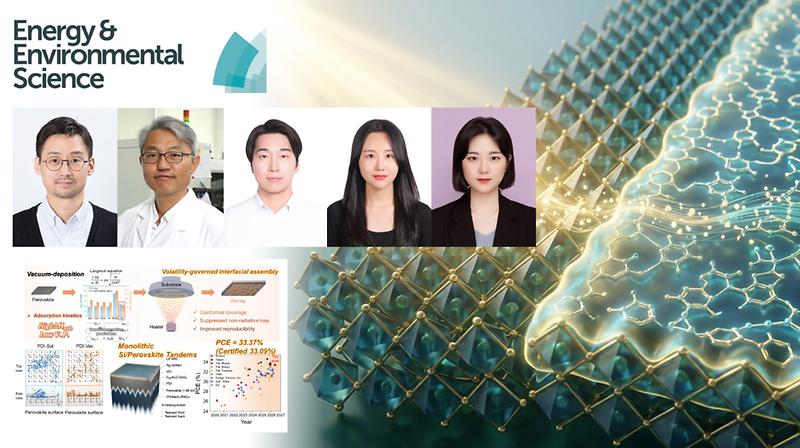
태양전지 표면에 증발시킨 물질 막 입혔더니 성능·품질 균일성 ↑

페로브스카이트 태양전지의 발전 효율과 내구성을 높이면서, 만들어지는 전지마다 성능도 균일하게 유지하는 기술이 개발됐다. 고효율 태양전지를 대량 생산하는 데 청신호가 켜졌다. UNIST 에너지화학공학과 양창덕·신소재공학과 최경진 교수팀은 특수 물질을 진공에서 휘발시켜 페로브스카이트 표면에 얇게 입힘으로써 태양전지 발전 효율과 내구성을 높였다고 20일 밝혔다. 페로브스카이트 태양전지의 페로브스카이트층과 전자수송층 사이에 패시베이션 물질이 입혀진다. 패시베이션 물질을 바르면 페로브스카이트층 상단의 결함 제거되면서 전자 손실이 줄어 태양광을 전기로 바꾸는 효율이 높아진다. 결함은 소재 손상이 시작되는 지점이기도 해서 전지 수명도 늘어난다. 이 물질은 주로 용매에 녹여 바르는데 일부가 뭉치거나 표면에 고르게 퍼지지 않아 에너지 손실이 발생하고 전지마다 성능이 들쭉날쭉해질 수 있었다. 반면 패시베이션 물질을 진공에서 가열해 휘발시킨 뒤 기체 상태의 분자가 페로브스카이트 위에 바로 내려앉도록 하면 표면에 공급되는 물질의 양과 쌓이는 속도를 조절해 균일한 막을 만들 수 있다. 이 같은 진공 증착은 균일한 막을 만들기 위해 반도체 공정 등에서도 많이 쓰이는 공정이다. 관건은 휘발 속도를 잘 제어할 수 있는 물질 자체를 찾는 일이었다. 너무 쉽게 휘발되면 표면에 쌓이는 양을 조절하기 어렵고, 반대로 잘 휘발하지 않으면 더 높은 온도로 가열해야 해 물질 자체가 분해될 수 있기 때문이다. 연구팀은 패시베이션 물질 6종의 열 안정성과 휘발 특성을 비교해 ‘피페라지늄 다이아이오다이드(PDI)’를 선정했다. 이 물질을 초당 0.01나노미터씩 쌓자 용액으로 처리했을 때보다 분자들이 표면에 더 가깝고 고르게 붙어 결함에 따른 에너지 손실을 줄였다. 이 표면 처리 기술을 적용한 페로브스카이트 태양전지의 최고 효율은 26.05%로, 같은 물질을 용액으로 처리한 전지의 25.43%보다 높았다. 페로브스카이트와 실리콘을 위아래로 쌓은 탠덤 태양전지도 33.09%의 높은 공인 효율을 기록했다. 각각 12개 전지를 제작해 비교했을 때, 전지 간 효율 편차도 줄었다. 내구성도 향상됐다. 섭씨 65도에서 빛을 계속 비추며 작동시킨 시험에서 개발한 기술을 적용한 전지는 초기 효율의 90%를 유지하는 시간이 1,005시간으로, 용액으로 처리한 전지보다 약 55% 더 길어졌다. 이번 연구는 UNIST 에너지화학공학과 박지원·김지은 연구원, 신소재공학과 노영임 연구원이 제1저자로 참여했다. 박지원 연구원은 “패시베이션 물질의 휘발성을 하나의 설계 변수로 삼아 진공에서 휘발 속도를 안정적으로 제어함으로써, 페로브스카이트 표면에 균일한 막을 만들 수 있었다”고 설명했다. 양창덕 교수는 “이번 기술은 페로브스카이트 태양전지의 효율과 내구성을 높이면서 전지 간 성능 편차도 줄일 수 있는 방법”이라며 “페로브스카이트·실리콘 탠덤 태양전지에서도 33%가 넘는 인증 효율을 확보해 고효율 태양전지의 대면적·대량 생산에 도움이 될 것으로 기대한다”고 말했다. 연구는 친환경 에너지 화학 분야 권위지 저널인 에너지와 환경 과학(Energy & Environmental Science)에 9월 1일 출판됐으며, 과학기술정보통신부 한국연구재단, 기후에너지환경부 한국에너지기술평가원의 지원을 받아 이뤄졌다.

원자력공학과, ‘원자력 안전규제라운드테이블’ 개최

연구 2026년 09월 28일 월요일

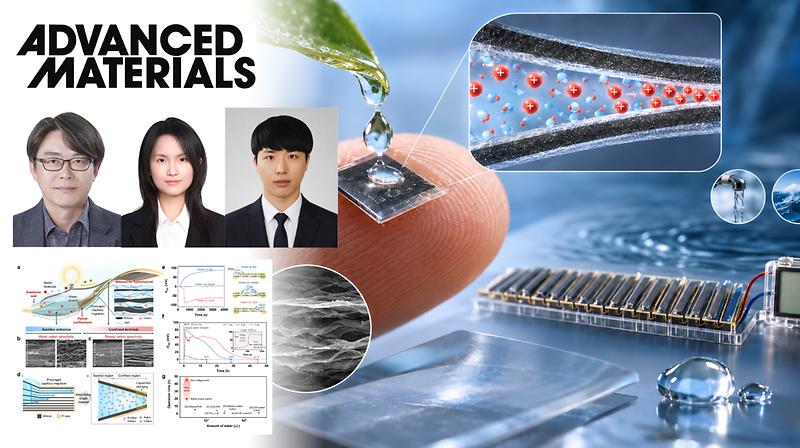
빗방울보다 적은 물로 45시간 전기 만든다!...초소형 ‘수력발전기’ 개발

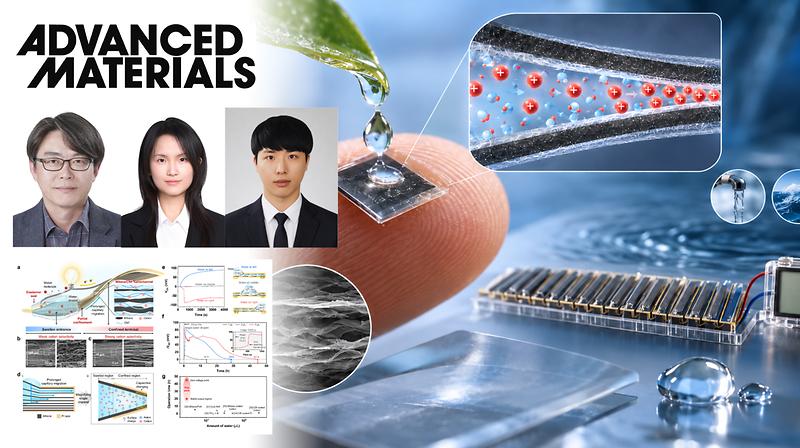
빗방울보다 적은 3마이크로리터(μL)의 물로 최대 45시간 전기를 만들 수 있는 손톱보다 작은 ‘수력발전기’가 나왔다. UNIST 에너지화학공학과 고현협 교수팀은 물속 양이온의 농도 차를 유도해 장시간 직류 전기를 생산하는 초소형 박막 수분 발전기를 개발했다고 9일 밝혔다. 일반적인 수력발전은 물이 높은 곳에서 낮은 곳으로 떨어질 때의 낙차로 터빈을 돌리는 반면, 연구팀이 개발한 초소형 발전기는 물속 양이온의 농도 차로 전압을 만들어 발전한다. 양이온의 농도 차를 만들기 위해 발전기 박막 속에 한쪽으로 갈수록 폭이 좁아지는 물 통로가 만들어지도록 설계됐다. 통로 벽은 물속에서 음전하를 띠는 맥신과 셀룰로스 나노섬유로 이뤄져 있는데, 통로가 좁아질수록 양이온이 통로 벽의 인력에 영향을 더 받아 좁은 구역의 양이온 농도가 넓은 구역보다 높아지는 원리다. 발전기의 박막은 켜켜이 쌓인 맥신 나노시트 사이사이에 셀룰로스 나노섬유가 들어가 있다. 한쪽 끝은 물을 잘 빨아들이는 셀룰로스 나노섬유가 부풀어 오르고, 반대쪽 끝은 테이프로 눌러 부풀지 못하게 한 구조다. 이 덕분에 물을 넣으면 반대쪽으로 갈수록 폭이 좁아지는 물 통로가 만들어진다. 또 박막 내부의 나노통로를 따라 물이 빠르게 퍼지는 모세관 현상이 일어나고, 켜켜이 쌓인 통로들에 순차적으로 물로 채워지면서 이온 이동 현상이 지속될 수 있다. 이 박막 발전기 하나의 크기는 가로 5밀리미터(㎜), 세로 7밀리미터로 손톱보다 작고, 실제 전기를 만드는 박막 두께도 15마이크로미터(μm)에 불과하지만, 단 한 번 3마이크로리터의 물만으로 20시간 이상 전압을 유지하고 최대 약 45시간 동안 전압을 출력해 낼 수 있다. 유연한 구조와 얇은 두께 덕분에 발전기를 여러 층으로 쌓을 수 있으며, 실제 2개 층으로 쌓은 단위 소자 48개를 직렬로 연결해 디지털시계를 직접 구동할 수 있었다. 또 수돗물·바닷물·땀 등을 가리지 않고 다양한 액체로 전력 생산이 가능했다. 이번 연구는 UNIST 에너지화학공학과 나상윤 박사와 정건영 박사가 공동 제1저자로 참여했다. 연구팀은 “이번에 개발된 발전기는 수분 발전기의 일종”이라며 “기존 수분 발전기는 물의 증발이나 흡습 현상에 의존해 이온의 농도 차를 유도했기 때문에 발전기를 밀폐 분리하기 어렵고, 주변 습도와 공기 흐름에 따라 출력이 달라지는 문제가 있었다”고 설명했다. 이어 “이번 발전기는 물의 증발이나 흡습 현상에 의존하는 대신, 박막 내부의 나노채널 구조를 통해 이온의 선택적 이동을 유도함으로써 외부 환경의 영향을 최소화하고 장시간 전기를 생산할 수 있도록 했다.”라고 덧붙였다. 고현협 교수는 “밀폐한 상태에서도 장시간 전압을 유지할 수 있는데다 얇고 유연하며 여러 층으로 쌓아 충분한 전력을 생산할 수 있다는 장점이 있는 만큼 웨어러블 전자기기뿐만 아니라 소형 센서, 분산형 전자기기 등 다양한 자가발전 전원 기술로 확장할 수 있을 것으로 기대한다”라고 말했다. 이번 연구는 과학기술정보통신부 한국연구재단의 과학기술분야 기초연구 사업, 국가과학기술연구회의 창의형 융합연구사업, 과학기술정보통신부·광주과학기술원(GIST)의 InnoCORE 프로그램의 지원으로 수행됐다. 이번 연구 성과는 Wiley에서 발행하는 세계적인 재료 분야 국제학술지인 ‘어드밴스드 머티리얼즈(Advanced Materials)'에 8월 12일자 온라인 게재됐다.

원자력공학과, ‘원자력 안전규제라운드테이블’ 개최

대학소식 2026년 09월 23일 수요일

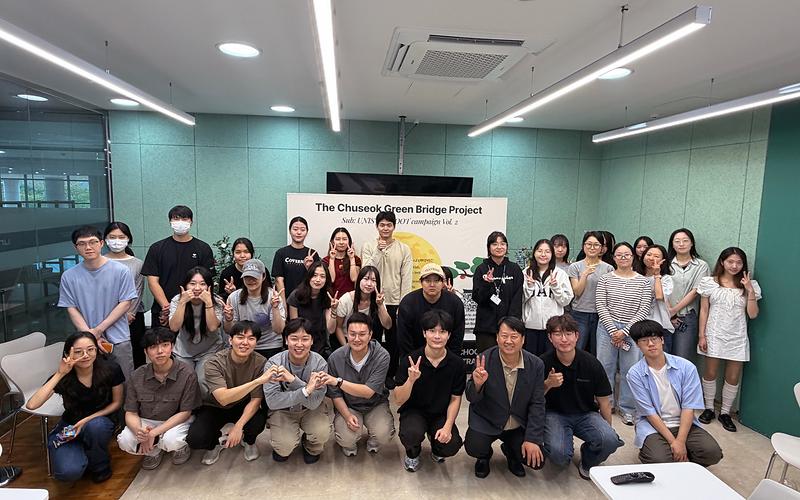
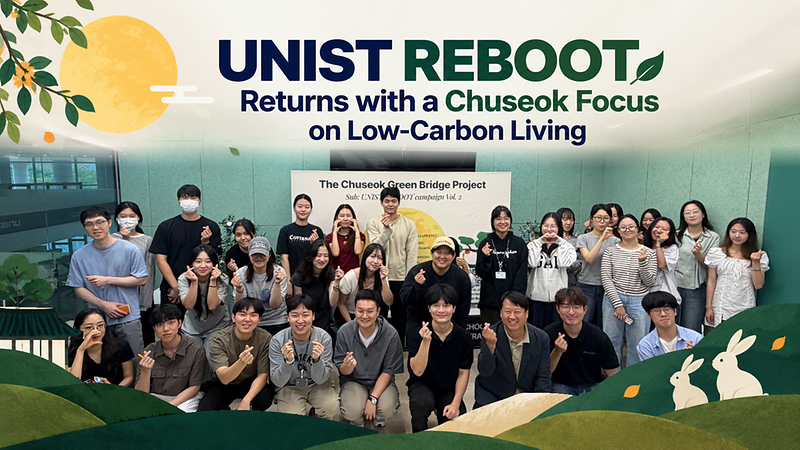
UNIST, 추석 맞아 탄소중립 실천하고 명절 온기 나눴다

탄소중립대학원이 22일(화) 104동 공학관에서 추석 명절을 맞아 ‘2026 UNIST REBOOT 2: The Chuseok Green Bridge Project’를 개최했다. 귀향길 대중교통 이용 등 일상 속 저탄소 실천에 명절의 정을 나누는 프로그램을 접목한 이날 행사에 80여 명의 내·외국인 재학생들이 참여했다. 이번 행사는 지난 6월 열린 ‘REBOOT’ 캠페인의 후속 시리즈다. 대학원 브랜드 가치를 높이고 탄소중립 문화를 캠퍼스 전반에 정착시키기 위해 에너지화학공학과에서도 협력했다. 온·오프라인을 병행한 현장 행사와 오프라인 후속 행사인 ‘Green Bridge Reward Day’로 나눠 진행됐다. 재학생들은 귀향길 대중교통 이용 등을 인증하는 ‘저탄소 실천 챌린지’에 참여했다. 행사장에 설치된 ‘소원 스티커 투표 보드’에서는 서로의 바람을 나누며 소통했다. 명절 분위기에 맞춰 선물도 마련했다. 참여자 전원에게는 세대별 취향을 고려한 이색 한가위 다과 키트를, 소원보드 우수 선정자에게는 부모님께 드릴 ‘효도 리워드’를 증정했다. 탄소중립 의미를 되새기고 가족을 향한 감사도 전할 수 있도록 구성했다. 외국인 유학생들도 적극적으로 동참해 국적의 구분 없이 어울리는 자리가 됐다. 행사에 참여한 한 학생은 “추석 전에 짧고 알차게 즐길 수 있는 유익한 행사였다”고 말했다. 김동석 탄소중립대학원장은 “대학원 개원 이래 두 학과가 뜻을 모아 개최한 이번 2탄 프로젝트는 구성원들의 자발적 참여 덕분에 성공적으로 마무리될 수 있었다”며 “학생들의 의견을 적극 반영해 재미와 의미가 있는 캠퍼스 소통 프로그램을 꾸준히 이어가겠다”고 밝혔다.

원자력공학과, ‘원자력 안전규제라운드테이블’ 개최

연구 2026년 09월 23일 수요일

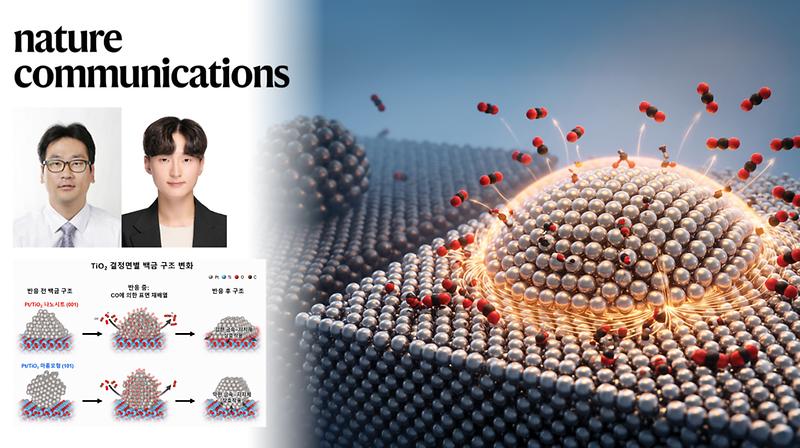
변하지 않는다던 촉매, 반응 중 모양 바뀐다.. "촉매 입자 올려진 결정면이 모양 좌우"

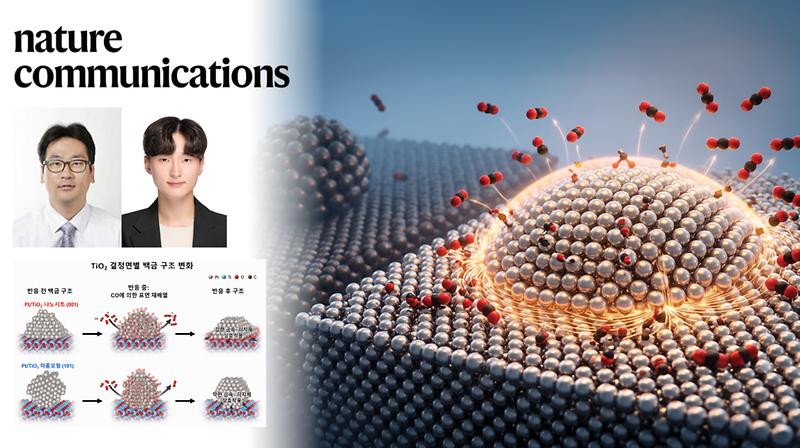
브리태니커 백과사전은 촉매를 ‘반응 속도를 높이지만 그 과정에서 소모되지 않는 물질’로 정의한다. 하지만 소모되지 않는 촉매 입자라도 반응 중에 그 모양은 바뀔 수 있는데, 이 모양 변화와 촉매 성능이 귀금속 촉매 입자가 올려진 지지체의 단면에 따라 바뀐다는 사실을 국내 연구진이 밝혀냈다. 귀금속 촉매 입자를 적게 쓰면서도 고성능을 내는 촉매 설계에 도움이 될 것으로 기대된다. UNIST 에너지화학공학과 안광진 교수팀과 서울대학교 재료공학부 한정우 교수팀은 백금을 올려놓는 지지체의 결정면(facet)이 반응 전후 백금 입자의 형태를 좌우해 촉매 성능을 높인다는 사실을 규명했다고 7일 밝혔다. 백금(Pt) 촉매는 배기가스 정화부터 수소 연료전지까지 다양한 화학반응에 쓰이는 물질이다. 나노미터 크기로 잘게 만든 백금 입자를 이산화티타늄 같은 지지체 위에 올린 형태로 쓴다. 이번 연구에 따르면, 일산화탄소를 이산화탄소로 바꾸는 데 필요한 활성화에너지는 백금을 이산화티타늄의 (101) 결정면에 올렸을 때보다 (001) 결정면에 올렸을 때 더 낮았다.결정면은 결정성 물질에서 특정 방향으로 드러난 표면을 말한다. 사과를 자르는 방향에 따라 단면에 보이는 씨와 과육의 모양이 다르듯, 결정성 물질도 표면이 드러난 방향에 따라 원자 배열이 달라진다. 연구팀은 이처럼 결정면마다 다른 원자 배열이 백금 입자의 초기 모양뿐만 아니라, 반응 중 구조가 바뀌는 방향까지 좌우해 활성화에너지 차이를 만드는 것으로 분석했다. 활성화에너지가 낮을수록 반응이 더 쉽게 일어난다. 실제 분석 결과, 이산화티타늄의 (001) 결정면에서는 백금이 물방울처럼 넓게 퍼진 반구 형태로 붙었다. 일산화탄소와 반응이 시작되면서 백금 입자의 표면이 거칠어지고 모양이 일부 변한 뒤에도 이산화티타늄과 넓게 맞닿은 구조는 유지됐다. 이 덕분에 첫 반응을 거친 뒤에는 일산화탄소를 이산화탄소로 바꾸는 데 필요한 활성화에너지가 처음보다 22.7~25.6% 더 낮아졌다. 반면 (101) 결정면에서는 백금이 공처럼 뭉친 입체 형태로 붙어 지지체와 맞닿는 부분이 좁았고, 반응 시작된 뒤에는 원자 배열이 더 정돈된 각진 입체 형태로 재배열됐다. 반복해서 반응시켜도 활성화에너지는 거의 달라지지 않았다. 연구팀은 전자현미경과 X선 흡수분광법으로 반응 전후 백금 입자의 모양과 주변 원자와의 결합 상태를 비교하고, 반응물이 생성물로 바뀌는 과정과 지지체 표면의 산소가 반응에 쓰였다가 다시 채워지는 과정을 상압 X선 광전자분광법과 같은 실시간 분광 분석으로 추적해 이를 밝혀냈다. 시뮬레이션 계산에서도 (001) 결정면 위의 백금이 지지체와 넓게 맞닿는 구조로 안정되면서 반응에 필요한 에너지 장벽이 낮아지는 것으로 나타났다. 안광진 교수는 “촉매는 반응 중 자신은 변하지 않으면서, 반응은 활성화 시켜주는 물질로 알려져 있지만, 정확히는 소모되지 않을 뿐 작동 중에는 형태와 구조가 달라질 수 있다”며 “ 정교하게 설계한 모델 나노 촉매와 첨단 분석법을 통해 이러한 변화를 추적함으로써, 반응 중 촉매가 어떻게 달라질지까지 고려해야 한다는 새로운 설계 방향을 제시했다”고 설명했다. 안 교수는 “백금은 에너지·화학산업에 필수적이지만 값비싼 귀금속 촉매”라며 “이번 연구에서 얻은 설계 원리는 적은 양의 백금으로도 반응성과 내구성을 높여 경제성을 확보하는 촉매 제조 기술에 활용될 수 있을 것”이라고 덧붙였다. 이번 연구는 한국화학연구원 윤신명 박사가 공동 교신저자로, UNIST 김지훈 박사, 서울대학교 김윤경 박사과정생이 제1저자로 참여했다. 과학기술정보통신부‧한국연구재단 (무탄소에너지를 활용한 e-SAF 생산 핵심기술 및 AI 기반 공정 시스템 개발)의 연구비 지원을 받아 이뤄졌으며, 세계적인 국제학술지 네이처커뮤니케이션즈(Nature Communications)에 8월 8일 자로 온라인 게재되었다.

원자력공학과, ‘원자력 안전규제라운드테이블’ 개최

대학소식 2026년 09월 10일 목요일

제2회 UNIST 파이오니어 심포지엄 성료 "차세대 배터리 기술 해법 모색"

배터리·나노과학 분야의 세계 석학들이 UNIST에서 차세대 에너지 기술의 해법을 모색했다. 지난해 전기화학에 집중했던 논의는 소재·에너지 화학 전반으로 넓어졌다. UNIST 에너지화학공학과는 8일(화)부터 9일(수)까지 대학본부 경동홀에서 ‘제2회 UNIST 파이오니어 심포지엄 2026(The 2nd UNIST Pioneer Symposium 2026)’을 성황리에 개최했다. 국내외 산학연 관계자 400여 명이 참석해 이틀간 최신 연구 성과를 공유했다. 올해 주제는 ‘소재 및 에너지 화학의 개척’이었다. 차세대 배터리 소재와 시스템, 전기촉매, 에너지 저장·변환 기술 등을 다루며 화학·소재 분야의 핵심 과제를 짚었다. 나노과학 분야의 권위자인 페이동 양(Peidong Yang) UC 버클리 교수와 배터리 양극재 분야 석학 아루무감 만티람(Arumugam Manthiram) 텍사스대 교수가 주요 연사로 나섰다. 만티람 교수는 2019년 노벨 화학상 수상자인 존 굿이너프 교수를 대신해 수상 강연을 맡은 바 있다. 전고체전지와 이산화탄소 전환 분야를 선도하는 미국 주요 대학의 신진 연구자들도 강연에 합류했다. 차세대 배터리 기술 연구를 총괄하는 김사흠 SK온 부사장 등 주요 대기업 리더들도 자리를 함께했다. 지난해 포럼에는 AI 기반 배터리 스타트업 등이 참여한 데 이어 올해는 대기업으로 산업계 접점을 넓혔다. 삼성SDI와 영국왕립화학회(RSC), 글로벌 출판사 와일리(Wiley) 등은 후원에 힘을 보탰다. 연구 포스터상도 만들어 학술단체와 출판사까지 아우르는 교류의 장이 마련됐다. 지난해 11월 처음 열린 심포지엄은 ‘전기화학의 혁신’을 주제로 스탠퍼드대 이 추이(Yi Cui) 교수 등을 초청했다. 배터리 에너지 저장, 수소 생산 전기촉매, 인공지능(AI) 기반 소재 개발이 당시 주요 의제였다. 올해는 연구 범위와 초청 연사 구성을 확대하고 기업·학술기관의 동참을 이끌어내며 정기 국제 학술대회로서 입지를 다졌다. 박종래 총장은 “UNIST 첨단기술을 바탕으로 산업도시 울산이 미래 모빌리티와 이차전지 산업의 새로운 도약을 준비하고 있다”며 “이번 심포지엄이 활발한 학문적 교류를 넘어 새로운 아이디어와 협력이 시작되는 계기가 되기를 바란다”고 밝혔다.

원자력공학과, ‘원자력 안전규제라운드테이블’ 개최

연구 2026년 09월 08일 화요일

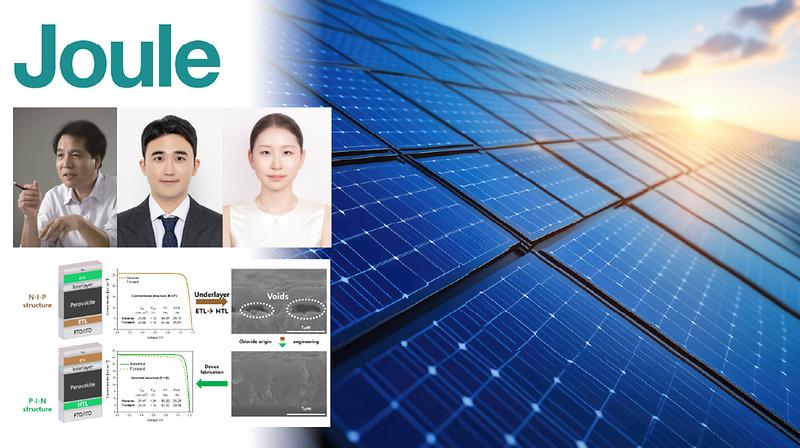
영하 100도, 영상 100도 오가도 작동하는 페로브스카이트 태양전지 개발

영하 100도(°C)부터 영상 100도를 오가도 작동할 수 있는 고성능 페로브스카이트 태양전지가 개발됐다. 극심한 온도 변화를 견뎌야 하는 우주용 페로브스카이트 태양전지 개발에 속도가 붙을 전망이다. 페로브스카이트 태양전지는 값싸고 가벼운 차세대 전지다. 에너지화학공학과 양창덕·신승재 교수와 신소재공학과 송명훈 교수팀은 200도에 이르는 온도 변화를 반복해도 정상적으로 작동할 수 있는 고성능 페로브스카이트 태양전지를 개발했다. 위성 등이 정해진 궤도를 돌다 보면 햇빛을 직접 받는 구간과 그림자에 들어가는 구간을 반복해 지나는데, 이때 온도 차가 200도 이상 벌어진다. 우주용 태양전지 개발에서 급격한 온도 변화를 반복해서 견디는 기술이 중요한 이유다. 연구팀이 개발한 전지는 영하 100도와 영상 100도에서 각각 30분씩 두는 열순환을 16차례 반복한 뒤에도 정상적으로 작동했다. 태양전지가 태양 빛을 전기로 바꾸는 효율인 광전변환효율의 감소가 줄어, 초기 성능의 약 91%를 유지했다. 이 같은 내구성은 연구팀이 개발한 자기조립단분자막(SAM) 소재인 ‘LY-m’ 덕분이다. 자기조립단분자막은 전극과 페로브스카이트층 사이에서 전하가 이동하도록 돕는 소재로, 분자들이 전극 표면에 스스로 정렬해 분자 하나 두께의 얇은 막을 만들 수 있다. 일반적인 SAM은 온도가 크게 바뀌면 이 내부 분자들이 다시 배열되거나 서로 뭉치면서 전극을 덮는 막이 불균일해질 수 있지만, LY-m은 분자들이 전극 표면에 촘촘하고 균일하게 배열돼 열을 받아도 이러한 재배열과 응집을 억제한다. 실제로 시판 SAM 소재를 적용한 비교 전지는 같은 극한 온도 변화를 반복하자 작동하지 않았다. 제1저자인 이승록 연구원은 “‘LY-m’은 유기반도체 소재로 쓰이는 카바졸과 전극에 달라붙는 포스폰산 부분을 페녹시프로필로 연결해 만든 물질”이라며 “페녹시프로필의 벤젠 고리에서 카바졸이 붙는 위치만 조절해 분자들이 전극 위에 비스듬히 서면서 촘촘하고 균일하게 배열되도록 만들 수 있었다”고 말했다. 태양 빛을 전기로 바꾸는 효율 자체와 장기 내구성도 뛰어났다. LY-m을 적용한 태양전지는 최고 26.39%의 광전변환효율을 기록했으며 공인 인증 효율도 26.37%를 기록했다. 또한 85도에서 장시간 가열하는 시험에서는 초기 효율의 80%를 유지하는 시간이 1,994 시간에 달했다. 이번 연구는 에너지화학공학과 이승록 연구원, 신소재공학과 양진규 연구원, 에너지화학공학과 박지원 연구원이 제1저자로 참여했다. 양창덕 교수는 “분자의 구성 자체를 크게 바꾸지 않고 연결 부위의 위치만 조절해 고효율과 극한 온도 내구성을 동시에 갖춘 소재를 설계했다”며 “가볍고 공정 비용이 낮은 페로브스카이트 태양전지를 우주와 같은 극한 환경에서도 활용할 수 있도록 하는 기술의 토대가 될 것”이라고 말했다. 연구 수행은 과학기술정보통신부 한국연구재단, 이노코어InnoCORE)사업의 지원을 받아 이뤄졌으며, 국제학술지 줄(Joule)에 8월 3일 공개 됐다.

원자력공학과, ‘원자력 안전규제라운드테이블’ 개최

연구 2026년 09월 04일 금요일

AI가 기후에 맞게 ‘고단백 미세조류 스피루리나’ 키운다!

고단백 차세대 식품 원료인 스피루리나를 다양한 기후에서도 키울 수 있도록 배양 조건을 자동으로 조절하는 인공지능(AI) 알고리즘이 나왔다. UNIST 탄소중립대학원 임한권 교수팀은 인도네시아대학교(University of Indonesia) 리에즈카 안디카(Riezqa Andika) 교수팀과 함께 다중 에이전트 강화학습 기반의 스피루리나 배양 AI 제어 알고리즘을 개발했다고 13일 밝혔다. 스피루리나는 단백질 함량이 60%에 이르고 필수아미노산, 비타민, 무기질도 풍부한 미세조류다. 농경지가 아닌 배양시설에서도 빠르게 자랄 수 있어 건강식품과 대체 단백질 원료로 주목받지만, 채산성을 맞추기는 까다롭다. 생산량을 늘리면서 조명과 냉난방에 쓰는 에너지를 줄여야 하는데, 지역과 계절에 따라 기온과 햇빛의 양이 크게 달라지는 데다, 빛과 온도, 영양분, 이산화탄소, 산성도 같은 생육 조건도 서로 영향을 주기 때문이다. 이산화탄소를 많이 공급하면 성장은 빨라질 수 있지만 배양액이 산성화돼 스피루리나의 광합성과 생장이 저해될 수 있고, 인공조명을 강하게 켜면 광합성에는 도움이 되지만 전력 사용량이 늘어나는 것이다. 연구팀이 개발한 알고리즘은 빛과 온도, 영양분, 이산화탄소, 산성도를 각각 담당하는 5개의 AI가 배양 상태와 기후에 맞춰 조명 밝기와 냉난방 출력, 각 물질의 투입량을 조절해 스피루리나의 생장은 높이고 에너지 사용량을 줄일 수 있다. 연구팀은 먼저 빛과 온도, 산성도, 영양분, 이산화탄소·산소 농도, 스피루리나 양 등 7가지 조건에 따라 생장과 배양 상태가 어떻게 달라지는지를 계산하는 가상의 배양 환경을 만든 뒤, 5개의 AI를 강화학습시켜 이 알고리즘을 만들었다. 강화학습은 AI가 각 선택의 결과에 따라 점수를 받으며 더 나은 방법을 익히는 학습 방식으로, 스피루리나는 잘 자라고 에너지는 적게 쓸수록 높은 점수를 주는 식이다. 온도가 기준보다 낮으면 히터를 최대 출력으로 켠다는 식의 미리 정해진 기준을 따르는 기존 방식과 달리, 여러 조건이 서로 영향을 주고 조절 효과가 시간차를 두고 나타나는 복잡한 상황에서도 배양 상태에 맞춰 각 조건의 조절량을 유연하게 결정할 수 있게 된다. 서로 다른 기후를 대표하는 8개 도시의 사계절 기상자료를 입력해 알고리즘을 평가해본 결과, AI 제어 방식으로 스피루리나 농도가 연구에서 가정한 수확 기준에 기존 방식보다 59시간 먼저 도달할 수 있었다. 건조 스피루리나 1㎏을 생산하는 데 필요한 에너지는 평균 14% 줄었으며, 계절별 기온 변화가 큰 울산에서는 최대 20%, 베이징에서는 21% 절감됐다. 이산화탄소 흡수량은 평균 78% 늘었고, 투입한 이산화탄소가 실제 스피루리나에 흡수된 비율도 44%에서 49%로 높아졌다. 제1저자 아흐마드 샤우키(Ahmad Syauqi) 연구원은 “AI로 미세조류를 더 빨리 키우는 데서 나아가, 기후가 달라도 에너지는 덜 쓰고 이산화탄소는 더 흡수하도록 배양함으로써 생산성과 지속 가능성을 함께 높이는 제어법을 마련했다는 데 의미가 있다”고 설명했다. 임한권 교수는 “현재는 가상환경에서 성능을 확인한 단계인 만큼, 앞으로 센서와 제어장치를 갖춘 실제 배양시설에서 검증해 농수산업 현장에서도 쓸 수 있는 기술로 발전시킬 계획”이라고 말했다. 본 연구는 UNIST 탄소중립융합원연구사업, 한국연구재단 및 과학기술정보통신부 지원으로 수행됐으며, 연구 결과는 농업공학 분야 최상위 국제학술지인 '바이오 리소스 테크놀로지(Bioresource Technology)'에 6월 19일 온라인 공개됐다.

원자력공학과, ‘원자력 안전규제라운드테이블’ 개최

대학소식 2026년 08월 28일 금요일

UNIST, 배터리 산학연 전문가 모아 AI 제조·인재양성 논의

UNIST가 국내 배터리 산학연 전문가들을 울산에 초청해 신진 연구자의 성장, AI 기반 배터리 개발·제조, 산업 협력 방안을 논의했다. 세션별 주제 토론과 지역 기업 홍보 부스, 울산테크노파크(울산TP) 견학이 함께 진행됐다. UNIST 에너지화학공학과는 27일(목)부터 28일(금)까지 대학본부 대강당에서 '제5회 이차전지 최신 연구개발 동향 토론회'를 개최했다. 이번 행사에는 국내 주요 대학과 기업, 연구기관 등에서 300여 명이 참석했다. 이번 행사는 UNIST 삼성SDI 산학인력양성과정 사업, POSTECH 이차전지 특성화대학원 지원사업, DGIST 이차전지 소재·셀 제조 산업 전문인력양성 사업과 이차전지 원자재 분자단위 분석 기반구축 사업을 기반으로 운영됐으며, 산업계에서는 포스코홀딩스, 에코프로 이노베이션, 엘앤에프 등 배터리 소재 분야 3사가 행사를 후원했다. 이번 토론회는 빠르게 변화하는 이차전지 연구개발 동향을 공유하고, 대학·기업·연구기관 간 협업 과제를 발굴하기 위해 마련됐다. 행사는 '신진 커리어', 'AI-Battery', 'Battery 산업'의 3개 세션으로 구성됐다. 각 세션은 연사 발표에 이어 참가자 전원이 참여하는 주제 토론으로 진행됐으며, 참가자들은 신진 연구자의 연구 환경, AI 기술의 적용 조건, 산업이 필요로 하는 배터리 연구를 놓고 활발히 질문과 의견을 주고받았다. '신진 커리어' 세션에서는 중앙대 장해성 교수, 광운대 김민경 교수, 부경대 채문석 교수가 연구자로 성장해 온 과정과 앞으로의 연구 방향을 발표했다. 좌장을 맡은 POSTECH 이민아 교수는 초기 경력 연구자의 진로 설계와 독자적인 연구 분야 구축을 주제로 토론을 이끌었다. 'AI-Battery' 세션에서는 DGIST 박인철 교수와 고려대 전규정 교수가 AI를 활용한 배터리 연구개발과 제조 혁신 전략을 제시했다. KAIST 서동화 교수의 진행으로 AI 도입 가능성과 데이터 활용, 적용 과정에서 해결해야 할 과제를 검토했다. 'Battery 산업' 세션에서는 POSTECH 이상민 교수와 UNIST 정경민 교수가 산업 현장에서 축적한 개발 경험을 바탕으로 한 이차전지 연구자의 덕목과 지향점을 공유했다. 이어 UNIST 곽원진 교수의 주재로 대학·기업·연구소 간 연구 목적의 차이, 그리고 그 사이의 연결과 균형을 바탕으로 한 국내 이차전지 산업의 발전 방향을 논의했다. 행사장에서는 후원사와 울산TP, 지역 대표 기업들이 홍보 부스를 운영해 보유 기술과 사업 내용을 소개했다. 행사 이튿날인 28일에는 참가자들이 울산테크노파크를 견학하며 연구실 규모를 넘어선 산업 스케일의 이차전지 전극·셀 제조, 진단, 재활용 설비를 직접 살펴봤다. 행사를 주관한 곽원진 교수는 "이차전지는 소재 혁신과 AI 융합, 산업 현장의 요구가 긴밀하게 맞물리는 국가전략산업의 핵심 분야"라며 "신진 연구자부터 산업 전문가까지 세대와 분야를 연결하는 이번 토론회가 공동연구와 후속 협력의 출발점이 되길 바란다"고 밝혔다. 한편, 올해로 5회째를 맞은 이 토론회는 2022년 UNIST에서 시작해 POSTECH, DGIST와 함께 돌아가며 개최해 왔다. 지난해 DGIST에서 열린 제4회 행사에서는 양극·음극 소재, 차세대 전지, 배터리 재활용 기술을 다뤘으며, 올해는 소재와 기술 중심의 논의를 신진 연구자 성장, AI 활용, 산업 협력 분야로 확장했다.

원자력공학과, ‘원자력 안전규제라운드테이블’ 개최

연구 2026년 08월 27일 목요일

레시피대로 옮겨도 쌓는 순서 바뀌면 효율 ‘뚝’..“원인은 태양전지 바닥에”

고효율 페로브스카이트 원료 배합을 그대로 옮겨 태양전지를 만들어도, 층을 쌓는 순서가 달라지면 효율이 뚝 떨어지는 이유를 국내 연구진이 찾아냈다. 페로브스카이트 광흡수층 아래에 놓이는 재료가 바뀌면서 결정이 자라는 방식도 달라졌기 때문이다. 역구조의 바닥 재료에 맞게 원료 배합을 손보자 태양전지 효율은 26.3%까지 올라갔다. 역구조 전지는 실리콘과 페로브스카이트 전지를 결합한 탠덤 태양전지의 상부 셀에 주로 쓰이는 만큼, 고효율 탠덤 전지 개발에 도움이 될 전망이다. UNIST 에너지화학공학과 석상일 특훈교수팀은 정구조 태양전지용으로 개발된 고효율 페로브스카이트 원료를 역구조에 적용할 때 성능이 떨어지는 원인을 규명하고, 첨가 물질을 바꿔 고효율 역구조 페로브스카이트 태양전지를 개발했다고 5일 밝혔다. 페로브스카이트 태양전지는 용액을 바르는 공정으로 얇고 가볍게 만들 수 있는 차세대 태양전지다. 특히 역구조는 아래 실리콘 전지로 전달되는 빛의 손실이 적어, 현재 고효율 페로브스카이트·실리콘 탠덤 태양전지의 상부 셀에 주로 쓰인다. 역구조는 유기물 정공전달층을 페로브스카이트 결정 박막 아래에 깔은 전지다. 연구팀이 밝혀낸 바에 따르면, 정구조에서 첨가량을 늘려 결정성장을 돕던 염화메틸암모늄(MACl)이 역구조에서는 첨가량이 늘어나면 결함을 발생시켰다. MACl이 들어간 페로브스카이트 원료 용액을 결정화하는 과정에서 중간물질이 생기는데, 이 중간물질이 열처리 시 뒤늦게 빠져나가면서 페로브스카이트층 바닥, 즉 아래 정공전달층과 맞닿는 매몰 계면에 빈틈과 결함이 생기는 것이다. 빈틈과 결함은 ‘전기 입자’인 전하가 손실되는 지점이 되고, 태양전지 효율이 떨어지게 된다. 연구팀은 MACl의 양을 기존 30몰%에서 10몰%로 줄이고, 대신 염화납을 2몰% 넣어 고효율 전지를 만들었다. 염화납이 염소를 납과 강하게 결합한 상태로 바닥 부근에 머물게 해, 결정이 생기기 시작하는 시점과 위치를 고르게 조절해 주는 원리다. 조절된 배합을 적용한 전지는 최고 효율이 26.3%까지 올라, 정구조와 맞먹는 효율을 기록했다. 반면 기존 원료 배합은 전지 효율이 정구조 대비 2/3 수준에 그쳤다. 한편, 페로브스카이트 결정의 성장 과정과 염화납이 염소를 붙잡아 두는 효과를 확인하는 데는 포항가속기연구소의 첨단 분석법이 활용됐다. 석상일 특훈교수는 “정구조용 원료 배합이 역구조에서 성능이 떨어지는 근본 원인을 찾아냈으며, 역구조 태양전지의 효율을 높일 수 있는 원리와 설계 방향을 제시했다는 데 의의가 있다”며 “페로브스카이트·실리콘 탠덤 태양전지의 고효율 상부 셀 개발을 주도해 나갈 것”이라고 설명했다. 이번 연구는 에너지 분야 권위 저널 중 하나인 줄(Joule)에 7월 28일 온라인 출판되었다. 연구 수행은 한국연구재단의 지원을 받아 이뤄졌다.

원자력공학과, ‘원자력 안전규제라운드테이블’ 개최

연구 2026년 06월 23일 화요일

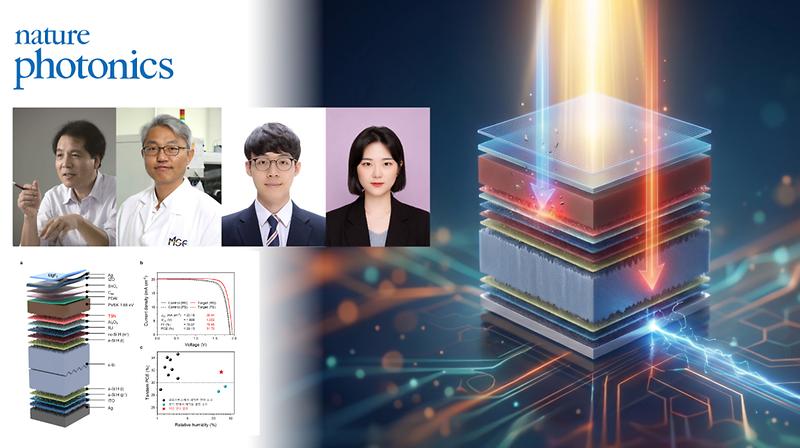
‘꿈의 태양전지’ 대량 생산 문턱 낮췄다!

페로브스카이트 태양전지 연구를 선도해온 UNIST 석상일 특훈교수 공동연구팀이 고효율 탠덤 태양전지의 대량생산에 필요한 계면 코팅 물질을 개발했다. 이 물질을 적용하면 수분과 산소에 노출되는 일반 공정을 통해서도 효율 30%가 넘어가는 페로브스카이트·실리콘 탠덤 태양전지를 만들 수 있게 됐다. 고효율 탠덤 전지 대량생산의 문턱을 낮춘 성과라는 평가가 나온다. 이번 연구는 광학·광자공학 분야의 세계적 학술지 네이처 포토닉스(Nature Photonics)에 6월 1일 공개됐다. UNIST 에너지화학공학과 석상일 특훈교수, 신소재공학과 최경진 교수팀은 사우디아라비아 KAUST 연구팀과 함께 3성분 물질을 이용한 전지 계면 코팅 물질을 개발했다고 11일 밝혔다. 페로브스카이트·실리콘 탠덤 태양전지는 페로브스카이트 전지와 실리콘 전지를 위아래로 쌓은 초고효율 전지다. 위쪽 페로브스카이트가 짧은 파장의 태양빛을 먼저 흡수하고, 아래쪽 실리콘이 남은 빛을 흡수해 기존 실리콘 태양전지보다 더 높은 효율을 낼 수 있다. 꿈의 태양전지로 불리며 중국을 비롯한 주요국이 주도권 확보 경쟁에 나선 이유다. 연구팀이 개발한 물질은 페로브스카이트층을 올리기 전, 전극 표면에 먼저 깔리는 얇은 접촉층이다. 이 층이 고르게 붙어 있어야 그 위에 바르는 페로브스카이트 용액도 균일하게 퍼지고, 전기 입자, 즉 전하가 사라지는 결함도 줄어든다. 기존에 쓰던 SAM 코팅층은 공기 중에 수분이 있으면 전극 위에 고르게 붙지 못하고, 페로브스카이트 용액을 바르는 과정에서도 쉽게 흐트러졌다. 고효율 전지는 수분과 산소를 차단한 특수 설비 안에서 만들어야 했고, 이는 대면적 생산 비용을 높이는 요인이 됐다. 연구팀의 3성분 물질은 기존 SAM 물질인 Me-4PACz 외에도 GDMA와 AG가 더 들어 있다. GDMA는 코팅층이 전극 위에 고르게 퍼지고 열처리 뒤 단단히 붙도록 돕고, AG는 페로브스카이트와 맞닿는 부분의 결함을 줄이는 역할을 한다. 결함이 줄어들면 빛을 받아 생긴 전하가 중간에 소실되지 않고, 그만큼 전하가 전극으로 더 잘 이동해 태양전지의 효율과 전압이 높아진다. 이 물질을 적용한 탠덤 전지는 일반 대기 중에서 만들었는데도 31.72%의 효율을 냈다. 이는 대기 중 제조 탠덤 전지 중 세계 최고 효율이다. 공인 인증 효율도 31.36%로 확인됐다. 내구성도 향상됐다. 겉을 감싸는 보호 포장 없이 85도의 뜨거운 공기 중에 600시간을 방치한 뒤에도 처음 성능의 92% 이상을 그대로 유지했으며, 실제 태양광을 모방한 강한 빛을 1,000시간 연속으로 쬔 후에도 90% 이상의 높은 효율을 지켜냈다. 이 물질은 페로브스카이트 전지 단독 제작 시에도 수율을 높일 수 있다. 7×7㎠ 대면적 기판에서도 페로브스카이트 박막이 고르게 만들어졌고, 불량률이 낮아졌다. 이번 연구는 UNIST의 김귀수 연구원, KAUST의 아디 프라세티오(Adi Prasetio) 연구원, UNIST의 노영임 연구원이 공동 제1저자로 참여했으며, UNIST 석상일 특훈교수, 최경진 교수, KAUST 스테판 드 울프(Stefaan De Wolf) 교수가 공동 교신저자로 참여했다. 홍콩중문대 선전캠퍼스, 독일 율리히 연구소 연구진도 함께 참여했다. 최경진 교수는 “정부의 ‘K-문샷 프로젝트’ 목표인 ‘초격차 초고효율 다중접합 태양전지’ 개발과 궤를 같이하는 연구”라며 “차세대 태양광 상용화에 크게 기여할 것으로 기대한다”고 말했다. 석상일 교수는 “고효율 탠덤 태양전지를 상용화하려면 성능뿐 아니라 실제 공정에서의 재현성과 생산 비용까지 함께 해결해야 한다”며 “이번 연구는 수분이 있는 일반 대기 중에서도 균일한 계면 박막과 높은 재현성을 확보할 수 있음을 보인 만큼, 대면적 제조 공정으로 확장하는 데 필요한 기술적 기반이 될 것”이라고 말했다. 이번 연구는 현대자동차, 과학기술정보통신부 한국연구재단(NRF), 기후에너지환경부 한국에너지기술평가원(KETEP) 등의 지원을 받아 이뤄졌다. (끝)

원자력공학과, ‘원자력 안전규제라운드테이블’ 개최

연구 2026년 06월 17일 수요일

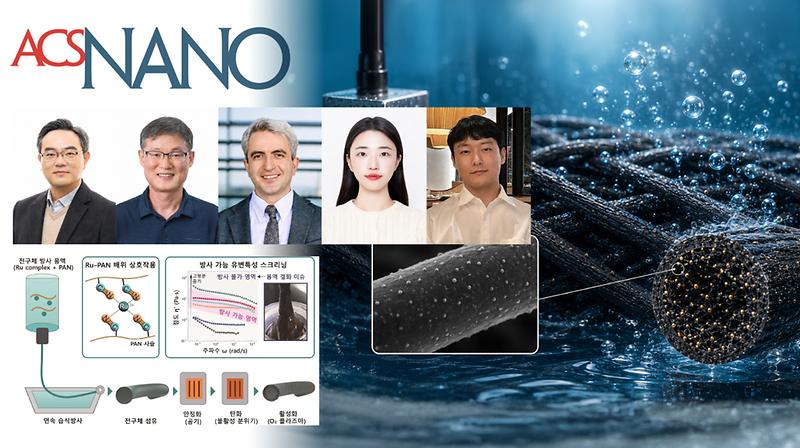
수소 생산 촉매 전극, 국수 가락처럼 뽑아낸다!

물에서 수소를 생산하는 촉매 전극을 국수 가락 뽑듯 제조하는 기술이 새롭게 개발됐다. 내구성과 반응성이 뛰어난 섬유형 수소 생산 전극을 대량으로 생산할 수 있는 길이 열렸다. UNIST 신소재공학과 채한기 교수팀과 에너지화학공학과 백종범 교수팀은 킹압둘라과학기술대학교(KAUST) 자페르 야부즈(Cafer T. Yavuz) 교수팀과 공동으로 루테늄 촉매를 탄소섬유 안에 균일하게 넣은 섬유형 수소 생산 전극 제조 기술을 개발했다고 7일 밝혔다. 물을 분해해 수소를 얻는 수전해 장치의 전극은 보통 전기가 잘 통하는 기판 위에 촉매를 발라 만든다. 촉매를 바를 때 접착제를 섞게 되는데, 접착제가 촉매 표면을 가려 반응을 방해할 수 있다. 반면 탄소섬유를 얽어서 전극을 만들면 섬유 자체가 전도체 역할을 할 수 있고, 섬유 사이로 물과 전해질도 잘 드나들고, 생성물인 수소도 빠르게 빠져나갈 수 있다. 개발된 기술은 이러한 섬유에 촉매를 쉽게 넣어 전극을 대량 생산할 수 있는 기술이다. 섬유를 먼저 만든 뒤 촉매를 따로 입히는 방식이 아니라 촉매를 섬유 원료에 넣어 함께 뽑아내는 방식이다. 탄소섬유 원료인 고분자 용액과 루테늄 촉매 원료를 섞은 되직한 액체를 노즐로 밀어내 실처럼 뽑고, 이를 열처리해 만든다. 루테늄 성분이 이 과정에서 탄소 섬유 안팎에 작은 촉매 입자로 자리 잡게 된다. 관건은 루테늄 성분이 들어간 고분자 용액을 끊기지 않고 섬유로 뽑아내는 일이었다. 탄소섬유 원료 고분자에 금속 성분을 섞으면 쉽게 뭉치거나 용액이 굳어져, 작은 노즐로 길고 균일하게 뽑아내기 어렵다. 연구팀은 탄소섬유 원료 고분자와 루테늄 성분이 서로 적당히 붙도록 조절해, 촉매가 고르게 섞인 상태로 섬유를 뽑을 수 있는 조건을 찾아낼 수 있었다. 연구팀은 섬유 안에 있는 촉매가 표면에 더 드러날 수 있도록 산소 플라즈마 처리를 거쳐 전극을 완성했다. 완성된 전극을 수전해 장치에 적용한 실험 결과, 고전류 환경에서도 내구성이 뛰어났다. 전극은 500 mA cm⁻²의 높은 전류 조건에서 170시간 동안 계속 작동했으며, 수소 기체가 계속 발생하는 동안에도 전극 형태를 유지했다. 또 전극에 입혀진 촉매 자체의 성능을 평가하는 실험에서는 상용 백금 촉매보다 우수한 성능을 보였다. 이번 연구는 UNIST 이가현 박사, KAUST 김석진 연구교수가 제1저자로, UNIST 백인경 연구원이 공동 저자로 참여했다. 연구팀은 “이번 연구는 루테늄 촉매가 들어간 고분자 용액을 섬유로 뽑아내는 조건을 찾고, 금속 성분이 열처리 과정에서 나노입자로 자리 잡는 과정을 함께 규명했다는 데 의미가 있다”며 “실험실 수준에 머물던 섬유형 촉매 전극 제조를 대규모 롤투롤 연속 공정으로 확장할 수 있는 기반을 마련했다”고 설명했다. 채한기 교수는 “이번 기술은 금속 촉매를 탄소섬유 안에 균일하게 넣어 전극의 구조적 안정성을 높인 것이 특징”이라며 “수전해 전극뿐 아니라 안정성과 균일한 반응성이 중요한 다양한 촉매 분야로도 확장될 수 있을 것”이라고 말했다. 이번 연구는 과학기술정보통신부와 교육부가 지원하고 한국연구재단이 주관하는 중견연구자 지원사업(개인기초연구), 리더연구자지원사업(창의연구)을 통해 수행되었으며, 연구 성과는 미국화학회(ACS)가 발행하는 나노·소재 분야 최상위 국제 학술지인 '에이씨에스 나노(ACS Nano; Impact Factor: 16.1, Cite Score: 24.2)'에 5월 19일 출판됐다.

원자력공학과, ‘원자력 안전규제라운드테이블’ 개최

연구 2026년 05월 30일 토요일

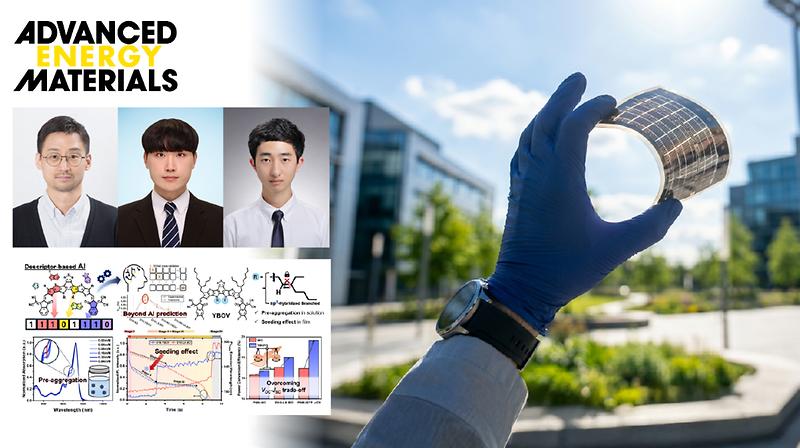
AI 예측 깬 고효율 유기태양전지 개발

분자 구조에 기반해 성능을 예측하는 인공지능 모델만으로는 설명하기 어려운 고효율 유기태양전지가 개발됐다. AI가 놓친 분자 간의 뭉침이 고성능의 비결이었다. UNIST 에너지화학공학과 양창덕 교수팀은 성균관대학교 고두현 교수팀과 함께 친환경 공정에서도 19.67%의 광전변환효율을 기록한 유기태양전지를 개발했다고 21일 밝혔다. 유기태양전지는 원료를 용매에 녹인 뒤 이를 기판에 코팅하는 방식으로 저렴하고 쉽게 제조할 수 있는 차세대 태양전지다. 가볍고 휘어질 수 있으며, 넓은 면적으로도 만들 수 있어 건물 외벽이나 창문, 웨어러블 기기 등에 적용할 수 있는 전지다. 연구팀은 유기태양전지 원료 분자의 곁가지 구조를 새롭게 설계한 YBOV 분자로 이 같은 고효율 전지를 개발했다. YBOV는 용매에 녹은 상태에서 분자끼리 뭉치게 되는데, 이 뭉침이 박막이 만들어지는 과정에서 결정 성장의 씨앗처럼 작용해 광활성층 박막의 분자 배열을 더 질서 있게 만들어주고 전지 성능이 개선된다. 광활성층은 태양빛을 받아 전하입자를 만드는 물질 층으로 광활성층 결정 배열이 반듯할수록 전지 성능이 좋아진다. 실제 YBOV 분자로 제조한 유기태양전지는 독성 염소 용매가 아닌, 친환경 오쏘자일렌 용매에 분자를 녹여 제조했을 때도 최대 19.67%의 높은 광전변환 효율을 기록했다. 또 YBOV는 다양한 광활성층 원료 조합에서도 뭉침 효과를 발휘해 전지 효율을 높일 수 있다. 유기태양전지의 광활성층은 전자주개 분자와 전자받개 분자로 이뤄지는데, YBOV는 전자받개 분자다. 전자주개 조합을 바꾸거나 별도의 전자받개를 쓰고 YBOV 분자를 첨가제처럼 소량 사용한 경우에도 모두 대조군보다 효율이 올라갔다. 이 같은 분자 간의 뭉침 효과는 유기태양전지의 성능을 예측하는 AI 모델에서는 잡아낼 수 없는 것으로 나타났다. 연구진이 750개의 유기태양전지 데이터를 학습시켜 만든 AI 모델이 유독 YBOV 분자가 들어간 유기태양전지의 개방전압을 낮게 예측한 것이다. AI 모델은 분자 하나의 구조만 보고 예측하기 때문에, 용액 속에서 분자들이 뭉치며 나타나는 복잡한 집단적 물리 현상까지는 계산해내지 못했다는 분석이다. 공동 연구팀은 “이번 연구는 분자 구조 자체뿐 아니라, 용액 상태에서의 집합 거동까지 고려한 새로운 설계 전략을 제시한 것”이라며 “친환경 공정과 결합해 고효율 전지를 만든 만큼 차세대 유기태양전지의 상용화 가능성을 높일 수 있을 것으로 기대된다”고 설명했다. 이번 연구에는 UNIST 정석환, 원동후, 쑨 저(Sun Zhe) 연구원이 공동 제1저자로 참여했다. 연구 결과는 에너지 소재 분야 국제학술지인 어드밴스드 에너지 머터리얼즈(Advanced Energy Materials)에 4월 20일 게재됐으며, 과학기술정보통신부 한국연구재단, 이노코어사업의 지원을 받아 이뤄졌다. (끝)

원자력공학과, ‘원자력 안전규제라운드테이블’ 개최

Research 2026년 10월 01일 목요일

Beyond Ideal Conditions

《Editor's Note: Research works by controlling variables. But the problems it ultimately confronts rarely offer the same courtesy. Heat gets into storage tanks. Expertise shifts from one question to the next. Satellite images arrive out of season. Materials face conditions far beyond the laboratory norm. The obvious response is to restore control —keep the heat out, remove the variation, recreate the ideal test. But what happens when ideal conditions are no longer an option? This month, UNIST researchers took that question in different directions. Some intervene before a problem takes hold —or after a familiar line of defense has failed. Others design for rather variation than uniformity, or put promising results to more demanding tests. The approaches differ, but the underlying shift is the same —rather than trying to restore control, they rethink the solution around what actually changes.》 CHANGE WHERE YOU INTERVENE “Sometimes the best place to solve a problem is not where it appears.” For atomically thin semiconductors, contamination during fabrication can be especially difficult to undo. Plasma exposure changes the chemistry of photoresist, causing residue to bind more strongly to MoS₂. Aggressive cleaning, meanwhile, risks damaging the material itself. Rather than trying to remove the residue afterward, UNIST researchers placed a removable, 5-nanometer metal layer over the semiconductor before patterning, preventing the contamination from reaching its surface. The resulting transistors showed roughly a tenfold reduction in contact resistance and a similar increase in on-current. Liquid hydrogen presents the problem from the opposite direction. Even well-insulated tanks cannot keep heat out indefinitely. Instead of treating insulation as the only line of defense, researchers investigated whether metal-organic frameworks could capture evaporating hydrogen after heat enters the tank and slow the buildup of pressure. In modeling, IRMOF-20 preserved about 97 percent of the volumetric capacity of liquid hydrogen while extending the projected storage period from roughly 64 to 221 days. One solution acts before the problem reaches the material: the other takes effect after a familiar line of defense has been breached. In both cases, changing where researchers intervene changes what can be done about the problem. ■ New Process Shields 2D Semiconductors from Fabrication Residue (Small) ■ Rethinking Liquid Hydrogen Storage with MOFs (Nature Communications) WORK WITH WHAT CHANGES “When the world refuses to stay consistent, the method has to change with it.” Personalization gets harder when expertise refuses to stay fixed. A person who is an expert in one subject may be a novice in another—and even within the same field, expertise can change from question to question. ExPerT responds to that variation rather than smoothing it away. By combining the semantics of each query with patterns in a user's typing behavior, the framework estimates expertise for individual questions and adjusts the detail, terminology, and complexity of its answers accordingly. In a study involving 40 participants and 1,270 queries, it reduced expertise-estimation error by 65.7 percent compared with the strongest baseline. For wildfire assessment, the changing conditions are not the user but the landscape. Satellite images taken before and after a fire may come from different seasons, allowing natural changes in vegetation to be mistaken for fire damage. Instead of requiring seasonally matched images, UNIST researchers use nearby unburned vegetation to estimate seasonal change and correct the comparison. Across 12 US wildfires, it achieved a correlation of 0.72 with field observations using seasonally mismatched imagery—nearly matching the 0.73 obtained with images from similar seasons. One method adapts to knowledge that changes from question to question—the other accounts for landscapes that change with the season. Neither requires the variation to disappear before the analysis can begin. ■ AI Personalization Adapts Answers to What Users Know (ACL '26) ■ Assessing Wildfire Burn Severity Across Seasons (Remote Sens. Environ.) TEST WHAT HOLDS UP “A promising result means more when it holds up under a more demanding test.” Perovskite solar cells (PSCs) have reached impressive efficiencies, but performance under controlled conditions tells only part of the story. UNIST researchers developed a molecular interface that delivered a certified power-conversion efficiency of 26.37 percent, then subjected the cells to repeated swings between −100°C and +100°C. After 16 cycles, they retained about 91 percent of their initial efficiency—putting their stability to a far more demanding test. AI highlight detection faces a different gap between promising results and meaningful tests. Existing benchmarks have largely relied on videos lasting only a few minutes, even though real sports broadcasts can run for hours. SVHighlights closes the gap with 320 videos across eight sports and 640.18 hours of footage. Its videos average about two hours—roughly 30 to 60 times longer than those in existing datasets—allowing AI models to be evaluated under conditions much closer to the task they are meant to perform. One study subjects a material to extreme temperature swings, while the other tests AI against the scale of the task it is meant to perform. Both ask the same question: Does a promising result still hold when the test starts to resemble the challenge it is meant to meet? ■ PSCs Hold Up Under Extreme Temperature Swings (Joule) ■ AI Sports Highlight Detection to a More Realistic Test (ACM KDD '26) Explore the latest issue and follow 『The UNIST Brief』 on LinkedIn to stay updated. Subscribe via LinkedIn

원자력공학과, ‘원자력 안전규제라운드테이블’ 개최

Research 2026년 09월 29일 화요일

Less Than a Drop of Water Generates Electricity for Up to 45 Hours

Abstract Hydrovoltaic power generation offers a promising route for sustainable energy generation, yet existing systems typically rely on evaporation-driven flow or environmental moisture gradients, limiting device encapsulation and compact integration. Here, we introduce a confinement-induced ion-selective mechanism that enables sealed hydrovoltaic power generation from minimal water input. By engineering asymmetric nanochannel confinement in MXene/cellulose nanofiber (CNF) composites, localized hydration generates spatially distinct cation selectivity, establishing a persistent ion gradient and a confinement-dependent Donnan potential that drives capacitive charge accumulation. The harvested energy derives from substantial interfacial free energy released upon hydration of nanochannels with a high surface-to-volume ratio. Slow capillary migration then delays relaxation of the ion gradient, sustaining this charging and prolonging the resulting direct current (DC) output, without reliance on evaporation-driven flow or ambient humidity. Consequently, a single 3 µL water droplet enables stable DC output for up to 45 h. The device operates robustly under airflow (5–20 L min−1), relative humidity (17%–90%), and various electrolytes (tap water, seawater, and sweat), demonstrating humidity-insensitive, sealed operation. This confinement-governed hydrovoltaic framework expands the mechanistic understanding of water-enabled energy generation and provides a scalable platform for wearable and distributed electronics. A hydrovoltaic generator developed at UNIST can produce electricity for up to 45 hours from just 3 microliters (µL) of water, without relying on evaporation or ambient humidity. Led by Professor Hyunhyub Ko of the School of Energy and Chemical Engineering at UNIST, the research team developed a thin-film device that creates an ion imbalance within its own nanoscale channels. This allows the generator to operate while sealed, addressing a key limitation of hydrovoltaic systems that depend on evaporation or moisture in the surrounding air. Many hydrovoltaic devices rely on evaporation or environmental moisture to sustain electrical output, making their performance sensitive to humidity and airflow. The UNIST device instead generates electricity through the way water and dissolved ions move through channels built into the film itself. The film consists of stacked MXene nanosheets and cellulose nanofibers (CNFs). When water enters the film, one end swells while the other remains constrained, creating channels that gradually narrow from one side to the other. These narrowing channels interact differently with positively charged ions in the water, creating an uneven distribution of ions across the film. The resulting ion imbalance creates an electrical potential across the film. Water then moves slowly through the channels by capillary action, helping maintain the ion imbalance and sustain the electrical output for an extended period. A single device measures just 5 by 7 millimeters, with an active film only 15 micrometers thick. With a single 3 µL dose of water, it maintained voltage for more than 20 hours and continued producing an output for up to approximately 45 hours. The thin, flexible films can also be stacked to increase output. In one demonstration, the researchers connected 48 two-layer units in series to directly power a digital clock. The generator worked with tap water, seawater, and sweat, and remained stable across relative humidity levels from 17% to 90% and airflow rates from 5 to 20 L min⁻¹. “Most hydrovoltaic systems rely on evaporation or moisture in the surrounding air, but our device creates the necessary ion difference within the film itself,” said Professor Ko. “This allows it to maintain electrical output even when sealed. Its thin, flexible structure also makes it possible to stack multiple devices, which could support future applications in wearable electronics, compact sensors, and distributed devices.” The study was published online in Advanced Materials on August 12, 2026. Sangyun Na and Geonyoung Jung of UNIST contributed equally as first authors. The research was supported by the National Research Foundation of Korea (NRF), the National Research Council of Science & Technology (NST), and the InnoCORE Program of the Ministry of Science and ICT (MSIT) and Gwangju Institute of Science and Technology (GIST). Journal Reference Sangyun Na, Geonyoung Jung, Yoojin Chang, et al. , “Confinement-Induced Donnan Potential Enables Sealed Hydrovoltaic Power From Microliter Water,” Adv. Mater., (2026).

원자력공학과, ‘원자력 안전규제라운드테이블’ 개최

Research 2026년 09월 28일 월요일

New Study Finds Crystal Surface Directs How Platinum Catalysts Reshape During Reactions

Platinum (Pt) nanoparticles can change shape while catalyzing a reaction, and the surface beneath them helps determine how that transformation unfolds. A research team, led by Professor Kwangjin An of the School of Energy and Chemical Engineering at UNIST, together with Professor Jeong Woo Han's group at Seoul National University, found that different crystal facets of titanium dioxide (TiO₂) produce distinct Pt structures before and during carbon monoxide oxidation. The resulting differences at the Pt–TiO₂ interface have a pronounced effect on catalytic activity. Pt is widely used in catalysts for applications ranging from emissions control to fuel cells. Because the metal is expensive, it is typically dispersed as nanoparticles on a support, whose surface structure can influence both particle shape and reactivity. The researchers examined Pt nanoparticles about 1.8 nanometers across on two facets of anatase TiO₂, known as (001) and (101). Despite their similar size, the particles took on markedly different shapes. On the (001) surface, Pt spread across the TiO₂ to form a relatively flat, hemispherical structure with a broad interface. On the (101) surface, it remained more compact and faceted. The difference persisted as CO oxidation began. Pt on TiO₂(001) extensive retained contact with the support as its surface restructured during the reaction. On TiO₂(101), the particles developed a more ordered, cuboctahedral shape and maintained a more limited interface with the support. The two structures also showed substantially different catalytic behavior. Under the conditions tested, the apparent activation energy for CO oxidation was 58.1 ± 0.3 kJ mol⁻¹ on the predominantly (001)-faceted catalyst, compared with 109.1 ± 1.5 kJ mol⁻¹ on its (101)-dominated counterpart. The difference became more pronounced after the first reaction cycle. Across subsequent reaction cycles, its apparent activation energy fell by 22.7% to 25.6% relative to the first run, while the (101)-based catalyst changed little. The researchers traced this behavior to the interface that developed between Pt and TiO₂ during the reaction. At that interface, oxygen from the TiO₂ lattice participates directly in converting CO to CO₂, leaving oxygen vacuums that must then be replenished. The broader interface formed on TiO₂(001) allows this oxygen cycle to proceed more readily. Calculations likewise found lower energy barriers for oxygen activation on the (001) surface throughout the reaction pathway. To follow these changes, the researchers combined electron microscopy and X-ray spectroscopy with computational modeling. The experiments captured differences in Pt structure before and after reaction, while simulations reproduced the distinct particle shapes favored by the two TiO₂ facets. Density functional theory calculations then connected those structures to differences in reaction energetics. “A catalyst may not be consumed by a reaction, but that does not mean its structure remains unchanged while it is working,” said Professor An. “Our results show that the surface supporting a metal nanoparticle can determine not only its initial structure, but also how that structure evolves during the reaction. Understanding these changes could help guide the design of catalysts that make more effective use of costly metals, such as platinum.” Jihun Kim of UNIST and Yunkyung Kim of Seoul National University contributed equally as first authors. Sinmyung Yoon, Jeong Woo Han, and Kwangjin An served as corresponding authors. The study was published in August 2026 issue of Nature Communications , with support from the Ministry of Science and ICT (MSIT) and the National Research Foundation of Korea (NRF). Journal Reference Jihun Kim, Yunkyung Kim, Daewon Oh, et al. ,“TiO2-facet-dependent reconstruction of Pt nanoparticles during CO oxidation,” Nat., Commun., (2026).

원자력공학과, ‘원자력 안전규제라운드테이블’ 개최

News 2026년 09월 23일 수요일

UNIST REBOOT Returns with Low-Carbon Action for Chuseok

Students at UNIST brought low-carbon behaviours into their Chuseok celebrations this September, connecting sustainable travel with one of Korea's most important traditional holidays. and traditions into opportunities for everyday climate action. Held on September 22, 2026 UNIST REBOOT 2: The Chuseok Green Bridge Project brought together more than 80 Korean and international students for activities combining sustainable choices with the spirit of the holiday. The event was organized by the Graduate School of Carbon Neutrality in collaboration with the School of Energy and Chemical Engineering. The program builds on the first UNIST REBOOT campaign held in June, when more than 180 students took part in a five-day sustainability challenge and 87 completed all missions to become Net-Zero Masters. While the first campaign focused broadly on changing carbon-intensive habits, REBOOT 2 brought the concept into the Chuseok holiday period. Students were encouraged to document low-carbon choices, including the use of public transportation for holiday travel, and share their Chuseok wishes through an interactive sticker board. Participants also received holiday snack kits, while selected wish-board entries earned gifts intended for students to share with their parents. International students joined the activities alongside their Korean peers, adding a cross-cultural dimension to a program rooted in one of Korea's major holidays. “This second REBOOT project brought our two academic units together and was made possible by the enthusiastic participation of our students,” said Dong Suk Kim, Dean of the Graduate School of Carbon Neutrality. “We will continue to develop campus programs that reflect student ideas while making sustainability both meaningful and engaging.”

원자력공학과, ‘원자력 안전규제라운드테이블’ 개최

News 2026년 09월 11일 금요일

Successful Completion of 2026 UNIST Pioneer Symposium

UNIST brought together leading researchers in batteries, nanoscience, and energy chemistry for the second UNIST Pioneer Symposium, held from September 8 to 9, 2026. Hosted by the School of Energy and Chemical Engineering, the two-day symposium welcomed nearly 400 participants from academia, industry, and research institutions. Building on last year's focus on electrochemistry, the 2026 program broadened its scope to next-generation battery materials and systems, electrocatalysis, energy storage and conversion, and related areas of materials science. Featured speakers included Professor Peidong Yang at the University of California, Berkeley, and Professor Arumugam Manthiram at the University of Texas at Austin, internationally recognized for their work in nanoscience and battery materials, respectively. Professor Manthiram delivered the Nobel Lecture on behalf of John B. Goodenough following his 2029 Nobel Prize in Chemistry. The program also featured researchers working at the forefront of all-solid-state batteries, carbon dioxide conversion, and other areas of materials and energy science. Talks and panel discussions were complemented by poster sessions showcasing research by students and early-career scientists. Industry participation expanded this year, with Sa Heum Kim, Executive Vice President at SK On, who oversees next-generation battery research, joining representatives from major companies. The symposium was also supported by Samsung SDI, the Royal Society of Chemistry (RSC), Wiley, and other academic and research organizations. The Pioneer Symposium was launched in November 2025 with a focus on innovation in electrochemistry. The inaugural meeting featured Stanford University Professor Yi Cui and research spanning battery energy storage, electrocatalysis for hydrogen production, and AI-assisted materials development. This year's program broadened that scope while strengthening exchanges among researchers from academia and industry. Building on UNIST's research in advanced technologies, Ulsan is preparing for new opportunities in future mobility and secondary batteries,” said UNIST President Chong Rae Park. “I hope this symposium will foster meaningful scientific exchange and lead to new ideas and collaborations.”

원자력공학과, ‘원자력 안전규제라운드테이블’ 개최

Research 2026년 09월 08일 화요일

Perovskite Solar Cells Hold Up Under Extreme Temperature Swings

Summary The advent of self-assembled monolayer (SAM)-based hole-selective layers (HSLs) has revolutionized inverted perovskite solar cells (i-PSCs) by enabling record efficiencies, but they are constrained by incomplete surface coverage and interfacial heterogeneity. We devise topology-governed SAMs featuring isomeric linker patterns (LY-ortho [o], LY-meta [m], and LY-para [p]) and uncover the principle that conformational ordering dictates surface coverage and interfacial interaction coupling with perovskite. The topology-optimized LY-m forms a homogeneously dense, stable HSL with superior energy alignment and interfacial passivation. Devices incorporating LY-m achieve a record-high open-circuit voltage of 1.231 V, accompanied by an efficiency of 26.39% (certified 26.37%), while maintaining robust operational stability and scalability. Beyond laboratory metrics, LY-m-based devices withstand −100°C to 100°C thermal cycling with only ∼9% loss, far exceeding the operational limits of state-of-the-art commercial SAMs, while maintaining over 80% of their initial performance at 85°C (T80 ≅ 2,000 h). This work resolves the long-standing role of linker topology and paves the way for extreme-environment-resilient and scalable perovskite photovoltaics. Temperature swings are a major challenge for perovskite solar cells (PSCs), particularly in environments such as space, where materials may repeatedly move between extreme cold and heat. Led by Professors Changduk Yang and Seungjae Shin of the Department of Energy and Chemical Engineering and Professor Myung Hoon Song of the Department of Materials Science and Engineering at UNIST, the team developed perovskite solar cells that withstand such extremes by stabilizing a critical molecular interface. The cells retained about 91% of their initial efficiency after cycling between −100°C and +100°C, with a certified power-conversion efficiency of 26.37%. The key to this advancement is a self-assembled monolayer (SAM), a molecule-thin layer that helps move electrical charges between the electrode and the perovskite absorber. Under severe thermal stress, SAM molecules can shift or cluster, disrupting the interface and degrading performance. The team addressed this problem by changing where the molecular components of the SAM connect. They synthesized three versions with different linker positions and found that LY-m adopted a tilted orientation, allowing its molecules to pack densely and uniformly on the electrode. This arrangement also suppresses the molecular reorganization that can occur under large temperature swings. In thermal-cycling tests, LY-m cells were held alternately at −100°C and +100°C for 30 minutes at each temperature over 16 cycles. They remained operational with only about a 9% loss in efficiency, while cells using a commercial SAM failed under the same conditions. LY-m cells also reached a peak efficiency of 26.39%, with a certified efficiency of 26.37% and an open-circuit voltage of 1.231 V. At 85°C, they maintained more than 80% of their initial performance for approximately 2,000 hours. The approach also performed well at larger scales: a 1 cm² cell achieved 23.25% efficiency, while a 3 × 1 cm² mini-module reached 21.20%. “By changing only the position of the molecular connection, we were able to control how the molecules pack on the electrode,” said Professor Yang. “The resulting interface combines high efficiency with thermal stability, offering a promising route toward perovskite photovoltaics for environments with extreme temperature variations.” The study has been participated by Seunglok Lee and Jeewon Park of the Department of Energy and Chemical Engineering and Jingyu Yang of the Department of Materials Science and Engineering at UNIST, as co-first authors of the study. Published in Joule on August 3, the study has been supported by the Nano & Material Technology Development Program through the National Research Foundation (NRF) of Korea and the InnoCORE program of the Ministry of Science and ICT (MSIT). Journal Reference Seunglok Lee, Jinkyu Yang, Jeewon Park, et al., "Topology-governed self-assembled monolayers enable perovskite solar cells stable at −100°C to +100°C," Joule , (2026).

원자력공학과, ‘원자력 안전규제라운드테이블’ 개최

Research 2026년 09월 01일 화요일

Rethinking What Matters

《Editor's Note: What does it take to make something work better? The answer may be to pare back what is unnecessary, rethink how existing parts are arranged, find another route around a constraint, or widen the frame of the problem itself. This month's UNIST research offers answers in many forms—from leaner AI systems and redesigned material structures to an unexpected route for electron transfer and a broader view of cancer drug resistance. Some of those answers run counter to what we might expect. 》 Less Can Be Enough “How much does AI really need?” AI has spent years scaling up. But recent UNIST research asks a different question—how much can be taken away while keeping what matters? At ACL 2026, researchers introduced GMoE, an architecture that shares experts across layers rather than repeatedly storing similar ones. It cut model parameters by about 63 percent, from 549 million to 204 million, while average accuracy remained virtually unchanged—39.51 percent, compared with 39.55 percent for the baseline. The next target was data. Presented at ICML 2026, CSOR removes redundant training images while preserving meaningful variation within each identity. Using roughly half the original dataset, models retained more than 95 percent of full-data performance in re-identification (ReID) tasks. A third study moved to hardware. An automated design framework for logic-in-memory (LiM) computing optimized the placement and routing of computing elements, cutting computation cycles by 19.6 percent under area constraints. ■ GMoE—Expert Sharing for Smaller AI Models (ACL 2026) ■ CSOR—Less Training Data for ReID AI (ICML 2026 ) ■ LiM—Smarter Chip Design (IEEE TCAD) Arrangement Matters “In materials, where can matter as much as what.” More iron, less corrosion. Iron (Fe) is one of magnesium's most damaging impurities, yet UNIST researchers produced a Mg alloy containing more than six times as much Fe as ultra-high-purity Mg—and it still corroded more slowly. Instead of removing the impurity, the team added scandium (Sc) to form core–shell particles that isolate Fe-rich regions from the surrounding Mg. The corrosion rate fell from 22.2 to 0.38 millimeters per year, nearly a 60-fold reduction. At the molecular scale, thermal annealing changed the packing of an organic semiconductor, more than tripling its absorption dissymmetry and even reversing its preferred handedness of circularly polarized light (CPL). The resulting near-infrared (NIR) photodetector achieved a dissymmetry factor of 0.1 at 850 nanometers. The scale shifts again in perovskite solar cells (PSCs). The same high-efficiency formulation crystallized differently depending on the buried interface beneath it. Tailoring the chloride chemistry to the inverted architecture produced a device with 26.3 percent efficiency and a fill factor (FF) of up to 86.8 percent. ■ Mg Alloy—Shielding Fe to Slow Corrosion (Science Advances) ■ NIR Photodetector—Turning Molecular Packing (Advanced Science) ■ PSCs—Why Architecture Changes Performance (Joule) Another Way Through “How spin opens a new route for electron transfer.” Conventional energetics suggested that electron transfer should be unfavorable. Yet in manganese (Mn)-doped quantum dots (QDs), spin-exchange interactions enabled transfer more than ten times faster than in undoped QDs. The mechanism could help capture energetic hot electrons before their excess energy dissipates—a longstanding challenge in photocatalysis and solar-energy conversion. ■ Hot Electrons—Spin-Enabled Transfer (Nature Communications) Beyond the Tumor “The cells helping cancer resist treatment.” Some of the cells helping breast cancer resist treatment are not part of the tumor at all. UNIST researchers found that nearby fat cells can become cancer-associated adipocytes, which release complement factor D and activate survival signaling in cancer cells. In mouse models, disrupting this TRAP1-driven communication improved the response to chemotherapy, pointing to surrounding adipocytes as potential therapeutic targets alongside the tumor itself. ■ Breast Cancer—How Nearby Fat Cells Drive Drug Resistance (STTT) Explore the latest issue and follow 『The UNIST Brief』 on LinkedIn to stay updated. Subscribe via LinkedIn

원자력공학과, ‘원자력 안전규제라운드테이블’ 개최

News 2026년 08월 31일 월요일

UNIST Brings New Perspectives to Battery Research and Development

More than 300 battery researchers and industry experts gathered at UNIST to examine how artificial intelligence, changing research priorities, and closer ties with industry are shaping battery research and development. Hosted by the School of Energy and Chemical Engineering, the 5th Forum on Recent Trends in Secondary Battery Research and Development brought together participants from universities, companies, and research institutes across Korea. Held from August 27 and 28, this year's program focused on three themes—career development for early-career researchers, the use of AI in battery R&D and manufacturing, and the relationship between academic research and industrial needs. Each session combined presentations with open discussion, allowing participants to compare perspectives across academia and industry. The first session examined how early-career researchers can establish independent research directions and navigate the early stages of an academic career. Haeseong Jang of Chung-Ang University, Minkyung Kim of Kwangwoon University, and Moonseok Chae of Pukyong National University shared their experiences, followed by a discussion led by Mina Lee of POSTECH. The AI-Battery session explored where artificial intelligence can contribute to battery development and manufacturing—and what is needed to put those tools into practice. Inchul Park of DGIST and KyuJung Jun of Korea University presented approaches to AI-enabled battery research, while a discussion led by Dong-Hwa Seo of KAIST addressed data use, implementation, and remaining technical challenges. The final session turned to the relationship between research and industry. Sang-Min Lee of POSTECH and Kyung-Min Jeong of UNIST drew on their development experience to discuss the priorities facing battery researchers. Professor Won-Jin Kwak of UNIST then led a discussion on how universities, companies, and research institutes—with different research goals and timelines—can work more effectively together. The exchange extended beyond the sessions. Sponsors, Ulsan Technopark, and regional companies presented their technologies at exhibition booths, and participants visited Ulsan Technopark on August 28 to see electrode and cell manufacturing, diagnostics, and recycling facilities at an industrial scale. “Battery research increasingly brings together materials innovation, artificial intelligence, and the needs of industry,” said Professor Kwak, who organized the forum. “We hope this meeting will provide a starting point for new research collaborations by connecting early-career researchers with colleagues across academia and industry.” Launched at UNIST in 2022, the forum has since rotated among UNIST, POSTECH, and DGIST. Last year's meeting focused on cathode and anode materials, next-generation batteries, and recycling. This year's program broadened that scope to consider not only battery technologies themselves, but also the researchers, digital tools, and partnerships behind their development.

원자력공학과, ‘원자력 안전규제라운드테이블’ 개최

Research 2026년 08월 28일 금요일

New X-Ray Mapping Technique Enables Non-Destructive Analysis of Large-Area Perovskite Solar Cells

Abstract Scaling perovskite solar cells (PSCs) into large-area modules requires precise control of structural uniformity and mechanical integrity. However, scalable deposition often introduces mesoscale heterogeneities, including grain-orientation disorder and lattice-strain gradients, which limit efficiency and stability. Here, we report an intact-film orthogonal two-dimensional X-ray diffraction mapping (2DXDM) technique that enables full-field, quantitative crystallographic analysis of large-area perovskite films without physical sectioning. The method resolves spatial variations in crystallinity, orientation coherence, and lattice strain across complete modules and is validated against conventional sectioned analyzes such as grazing-incidence wide-angle X-ray diffraction (GI-WAXD) and X-ray diffraction (XRD). Using this approach, we compare static spin-coating (SSC) and dynamic spin-casting (DSC). DSC yields more homogeneous films with relaxed lattice stress and controlled solvate evolution, thereby reducing edge defects. As a result, DSC-based modules achieve 23.0% efficiency (22.7% certified) over 86.4 cm2 and retain over 80% of their initial efficiency after 1,000 h of operation. Perovskite solar cells (PSCs) have reached impressive efficiencies at laboratory scale, but maintaining that performance in larger modules remains challenging. As the films grow larger, differences in crystal orientation and internal strain can develop across the surface, creating defects that reduce efficiency and long-term stability. A research team led by Professors Dong-Seok Kim and Jin Young Kim of the School of Energy and Chemical Engineering and Professor Tae Joo Shin of the Graduate School of Semiconductor Materials and Devices Engineering at UNIST, together with Dr. Yun Seop Shin of the Korea Research Institute of Chemical Technology (KRICT), has developed an X-ray technique that maps these structural variations across an intact perovskite film. Called two-dimensional X-ray diffraction mapping (2DXDM), the technique shows how crystallinity, crystal orientation, and residual strain vary across an entity film without damaging it. Conventional methods often examine selected regions, provide averaged measurements, or require samples to be cut into sections. PSCs are made by depositing a liquid precursor onto a surface, where it dries and crystallizes into a light-absorbing layer. Across a large area, differences in drying and crystallization can leave the center and edges with different structural properties. The researchers used 2DXDM to compare two methods for forming large-area films. In static spin-coating (SSC), the precursor solution is applied before the substrate is spun, while dynamic spin-casting (DSC) deposits the solution drop by drop as the substrate rotates. The resulting maps showed that DSC produced more homogeneous films, with more consistent crystal orientation and lower residual strain. Additional X-ray measurements linked this improvement to better control over colon drying and crystal formation, which helped reduce structural defects near the edges. The more uniform films also delivered strong performance at module scale. DSC-based modules reached a power conversion efficiency of 23.0% over an active area of 86.4 cm², with a certified efficiency of 22.7%. Encapsulated modules retained more than 80% of their initial efficiency after 1,000 hours under continuous illumination. “Conventional methods make it difficult to see how structure varies across an entire film, and cutting a sample for analysis can alter the strain already present” said Professor Shin. “With 2DXDM, we can examine the full area without damaging the film and identify where structural differences occur.” Professor Dong-Seok Kim added, “For large-area perovskite films, what matters is structural uniformity across the entire surface, not just at a few individual points. By showing how fabrication conditions affect that uniformity, this approach can help guide the development of more efficient large-area modules.” Dong Shin Kim of the Graduate School of Semiconductor Materials and Devices Engineering and Jae Hwi Lee of the School of Energy and Chemical Engineering at UNIST, served as first authors. The research used the UNIST-PAL 6D beamline at the Pohang Accelerator Laboratory. The findings were published online in Joule on July 23, 2026. The research was supported by the Ministry of Science and ICT (MSIT), Ministry of Education (ME), National Research Foundation of Korea (NRF), Ministry of Trade, Industry and Energy (MOTIE), Korea Institute of Energy Technology Evaluation and Planning (KETEP), Korea Institute for Advancement of Technology (KIAT), and Korea Research Institute of Chemical Technology (KRICT). Journal Reference Dongshin Kim, Jaehwi Lee, Dongmin Lee, et al ., “Intact-film orthogonal 2D X-ray diffraction mapping for crystallographic homogeneity evaluation in perovskite solar modules,” Joule , (2026).

원자력공학과, ‘원자력 안전규제라운드테이블’ 개최

Research 2026년 08월 19일 수요일

Study Reveals Why Perovskite Performance Changes Across Solar Cell Designs

Abstract A perovskite precursor solution that delivers power conversion efficiencies (PCEs) exceeding 26% in conventional nip solar cells exhibits severe performance losses when directly applied to inverted pin architectures, revealing that high-efficiency compositions are not inherently transferable. Here, we identify a buried-interface crystallization mismatch, arising from the distinct physicochemical natures of inorganic SnO2 electron-transporting layers and organic self-assembled hole-transporting monolayers (SA-HTLs), as the origin of this divergence. The methylammonium chloride (MACl)-associated intermediate phase, MA2Pb3I8·2DMSO, persists and decomposes with strong underlayer dependence, stabilizing beneficially on SnO2 but impeding crystallization on SA-HTLs. To overcome this limitation, we develop a chloride-origin engineering strategy that decouples chloride functionality from volatile organic ammonium species by incorporating low-solubility lead chloride (PbCl2) with strong Pb–Cl coordination. This enables controlled interfacial desolvation and nucleation on SA-HTLs, suppresses buried defects, and establishes buried-interface crystallization control as a design principle for architecture-convergent, high-efficiency perovskite solar cells. Building a high-performance solar cell takes more than getting the materials right. The same ingredients can produce very different results when the layers are arranged differently—and researchers at UNIST have discovered why. Led by Distinguished Professor Sang Il Seok of the School of Energy and Chemical Engineering at UNIST, the team found that the surface beneath the light-absorbing perovskite layer can determine how well its crystals form. By tailoring the material chemistry to that surface, the researchers developed an inverted perovskite solar cell with a power conversion efficiency of 26.3% and improved stability. PSCs can be built in conventional nip or inverted pin configurations. Both have reached high efficiencies, but formulations optimized for one do not necessarily perform as well in the other. Inverted cells are particularly important for perovskite–silicon tandem solar cells, where they are commonly used as the top cell. The researchers found that this performance gap originates at the buried interface, where the perovskite layer forms on the material beneath it. A formulation that achieved efficiencies above 26% in conventional cells lost much of its performance when transferred directly to an inverted design. The difference came down in part to methylammonium chloride (MACl), an additive used to improve perovskite crystal growth. In conventional cells, an intermediate formed by MACl supports crystallization on the underlying inorganic layer. But on the organic layer used in inverted cells, the intermediate persists longer, disrupting crystal growth and leaving behind voids and defects that can lead to electrical losses. Rather than removing chloride, the team changed how it was introduced. The researchers reduced the amount of MACl and added a small amount of lead chloride (PbCl2), whose stronger interaction with chloride helped control where and when crystals began to form. This produced a cleaner buried interface with fewer defects. With the revised formulation, the inverted cells reached a peak efficiency of 26.3% and a fill factor of up to 86.8%, while also showing improved stability. The results demonstrate that controlling how perovskite crystals form at the underlying surface can help high-performance materials work across different solar-cell designs. “High-efficiency formulations developed for conventional PSCs do not necessarily behave the same way in inverted devices,” said Professor Seok. “By identifying the origin of this performance loss, we established a way to control crystal formation at the buried interface. The findings provide a design direction for developing efficient inverted cells for high-performance perovskite–silicon tandem solar cells.” Their findings have been published online in Joule on July 28, 2026. The study was supported by the National Research Foundation of Korea (NRF). Journal Reference Jongbeom Kim, Nahye Shin, Chaehoon Jeon, et al ., “Buried-interface crystallization limits the transferability of high-efficiency perovskite precursor compositions,” Joule ,(2026).

원자력공학과, ‘원자력 안전규제라운드테이블’ 개최

News 2026년 08월 06일 목요일

UNIST to Host ACS Publications Forum on the Future of Nanoscience

UNIST brought together leading scientific journal editors and early-career researchers on July 31 for the ACS Publications Forum: The Future of Nanoscience , a daylong program focused on emerging research across nanoscience and materials science. Co-hosted by ACS Publications and the UNIST School of Energy and Chemical Engineering, the forum was held under the theme ' ACS Editors' Forum with Early-Career Leaders in South Korea .' The program combined editor sessions, research presentations, panel discussions, and a poster session, creating opportunities for researchers at different career stages to exchange ideas and explore new connections. The forum featured Editor-in-Chief Teri W. Odom of Nano Letters, Editor-in-Chief Xiaodong Chen of ACS Nano, and Editor-in-Chief Suzie Pun of ACS Nano Medicine. Editors from Chemistry of Materials, ACS Nano, and Nano Letters, as well as representatives from ACS Publications, also participated. The afternoon Emerging Scholar Program highlighted research by early-career scientists from UNIST and other universities in Korea. Presentations covered battery chemistry and materials, energy conversion, catalysis, polymer self-assembly, stretchable electronics, optoelectronics, AI sensors, and two-dimensional materials, reflecting the breadth of current research across energy materials, soft matter, and electronics. The program also included a poster session featuring student research. A panel discussion with journal editors provided another opportunity to exchange perspectives on scientific publishing and emerging directions in nanoscience, while networking sessions connected editors, faculty members, and early-career researchers. Organized by Professor Hyun-Wook Lee of the School of Energy and Chemical Engineering at UNIST, the forum was designed to connect established journal editors with emerging researchers and strengthen scientific exchange across the nanoscience community. The event's broader research scope ranged from battery chemistry and energy conversion to stretchable electronics and polymer self-assembly.

원자력공학과, ‘원자력 안전규제라운드테이블’ 개최

Research 2026년 08월 01일 토요일

Beyond the Obvious

《Editor's Note: The biggest scientific advances do not always come from discovering something new. Sometimes, they begin by seeing familiar problems in a new light. This month's stories invite us to look beyond the obvious. Across artificial intelligence, semiconductor materials, nanotechnology, and biomedical science, UNIST researchers examined assumptions, structures, and interactions that can easily go unnoticed—but often determine how a system behaves. Their findings show how a deeper understanding of what is already there can open new directions for discovery.》 Questioning Assumptions “The first answer is not always the right one.” Scientific discovery often begins by asking whether the original question was complete. Several AI studies featured this month did just that, revisiting assumptions about how machines learn, forget, reason, and communicate. In federated learning, researchers found that differences in camera viewpoints—not only privacy constraints or data distribution—can significantly affect how well AI models learn together. Another team showed that machine unlearning involves more than simply removing data: forgetting can unintentionally alter knowledge that should remain. Elsewhere, a new communication framework showed that effective cooperation among AI agents depends less on exchanging more information than on exchanging the right information. Other studies reconsidered how AI systems reason across multiple views of the same scene and explored how quantum computing could reduce the cost of training robust AI models. Different problems, but a common starting point: questioning the assumptions built into them. Together, these studies point to a simple lesson: better answers often begin with better questions. ■ Rethinking Federated Learning: Camera Viewpoints Matter (CVPR 2026) ■ Making AI Forget—Without Losing What Matters (ICML 2026 ) ■ Smarter Communication for Collaborative AI (ICML 2026) ■ Rethinking Multiview Reasoning (ICML 2026) ■ Quantum Algorithm Cuts the Cost of Training Robust AI (ICML 2026) Looking Beneath the Surface “The smallest details often hold the biggest clues.” Across materials science, biology, nanotechnology, and semiconductor engineering, UNIST researchers examined structures and interactions that are easy to miss but can have an outsized influence on how materials, devices, and biological systems behave. In semiconductor research, the spacing between neighboring atoms emerged as a critical factor in controlling material properties and device performance. At the nanoscale, researchers examined how the surface chemistry of quantum dots influences their behavior in imaging. Another study turned to microscopic wrinkles, showing how their geometry can reshape optical properties. The same attention to underlying mechanisms extended to biology, where researchers found that familiar forms of cell death do not always follow the pathways scientists expect. Together, these studies show how seemingly minor details—from atomic spacing and surface chemistry to microscopic geometry and cellular mechanisms—can fundamentally change our understanding of a system. Sometimes, the most consequential discoveries begin with something that was there all along, waiting to be examined more closely. ■ Atomic Precision for Better Semiconductors (Chem. Mater., 2026) ■ A New Perspective on QD Imaging (Nano Converg., 2026) ■ Wrinkles that Reshape Photonics (Adv. Funct. Mater., 2026) ■ When Cell Death Follows Different Rules (Cell Death Differ., 2026) Across very different fields, these studies share a common instinct: question the assumption, examine the detail, and look again. What appears familiar can still hold unanswered questions. Looking beyond the obvious is not simply how these discoveries were made. It is how scientific discovery moves forward. Explore the latest issue and follow 『The UNIST Brief』 on LinkedIn to stay updated. Subscribe via LinkedIn

u
  • 등록된 글이 없습니다.

미래에너지와 지속가능한 화학산업의 해법을 설계하는
에너지화학공학과의 다양한 소식
을 전달드립니다.

에너지화학공학과에서 진행중인
세미나 입니다.

View More

배너존